
That “Something’s Off” Feeling in English
You know the feeling: your sentence is correct, but it lands weird. That usually means the issue isn’t grammar, it’s tone. English changes fast…

Let’s talk about the tool everyone secretly uses: Grammarly.
It catches your typos.
Fixes your commas.
Adds “kindly” to your requests like seasoning.
But there’s one thing Grammarly can’t do:
Make you sound like a confident, fluent human in a real workplace.
Because even if your grammar is perfect, you can still sound:
Today’s post? Fixes that.
Here are real phrases professionals actually use to sound natural, polite, and powerful — without sounding robotic, weak, or fake nice.
Grammarly might say both are “correct”:
“Please advise.”
“Let me know if you have any thoughts.”
But only one of them doesn’t make you sound like a passive-aggressive lawyer.
(Hint: it’s not the first one.)
If you’re working in English but didn’t grow up with it, tone is your secret weapon.
Get it wrong, and people misread your emails.
Get it right, and they trust you more — even when you’re saying no.
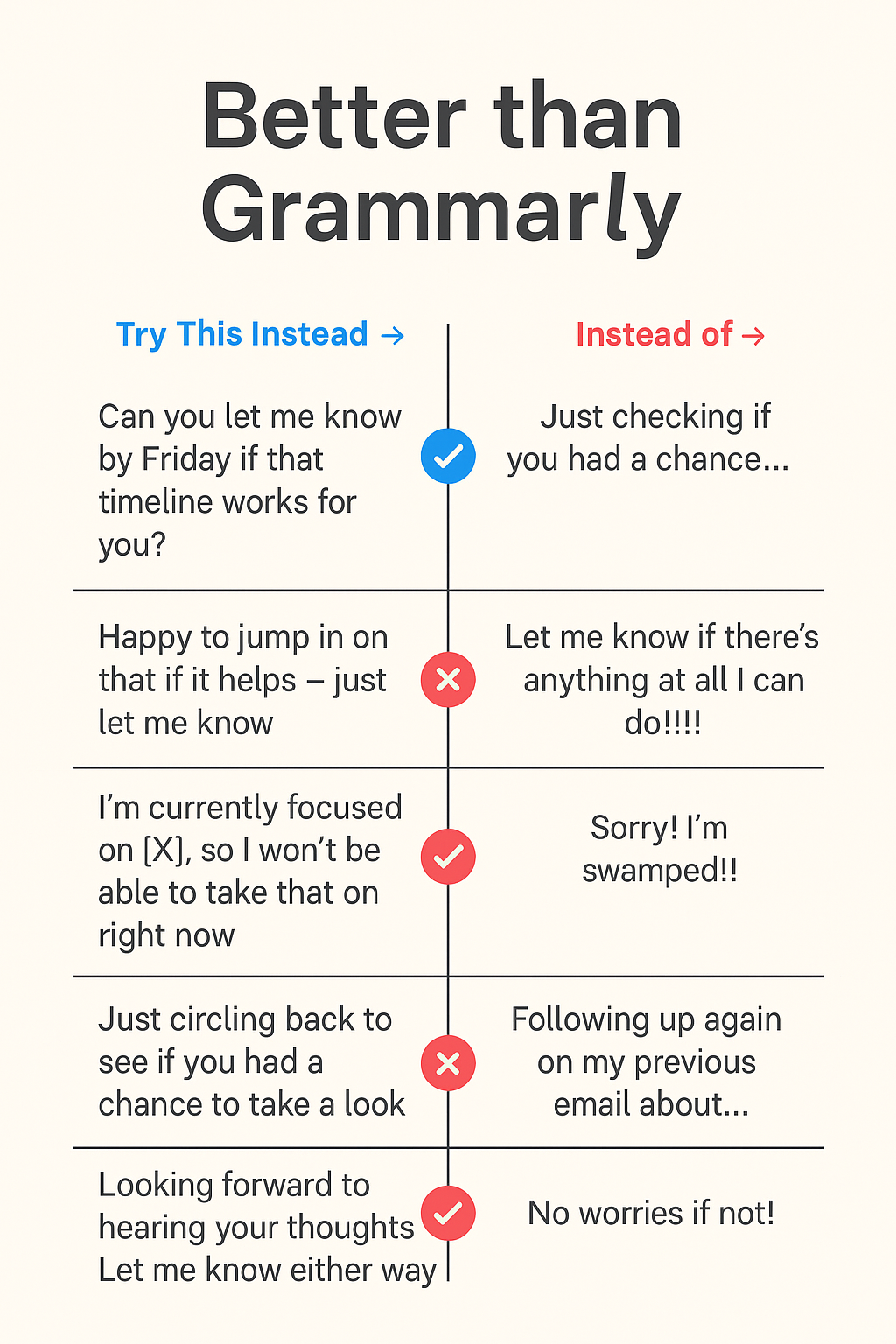
“Can you let me know by Friday if that timeline works for you?”
✅ Specific. Direct. Still polite.
🚫 Not: “Just checking if you had a chance…”
“Happy to jump in on that if it helps — just let me know.”
✅ Casual but generous.
🚫 Not: “Let me know if there’s anything at all I can do!!!”
“I’m currently focused on [X], so I won’t be able to take that on right now.”
✅ Boundaries. Professional. No drama.
🚫 Not: “Sorry! I’m swamped!!”
“Just circling back to see if you had a chance to take a look.”
✅ Friendly. Natural.
🚫 Not: “Following up again on my previous email about…”
(Also see “Let’s Circle Back”: Corporate English Phrases That Confuse Newcomers if that one makes your brain hurt.)
“Looking forward to hearing your thoughts.”
OR
“Let me know either way.”
✅ You’re not begging. You’re expecting a response.
🚫 Not: “No worries if not!”
Most professionals we work with don’t need help with English basics.
They need help sounding like themselves — confident, clear, and ready for leadership.
👔 That’s what we do.
Not sure if it’s pronunciation, confidence, rhythm, or something else entirely?
Take our quick English Accent Clarity Quiz to pinpoint what’s limiting your communication — and what will make the biggest difference fastest.
If you’d rather learn first and decide later, start here. These guides are organized by real communication goals, not textbook rules.
Love teaching English and helping people communicate clearly and confidently?
We’re always interested in thoughtful teachers who care about real-world results.
👉 Apply to teach with TalktoCanada
Have questions about lessons, programs, or where to start?
Not sure which option is right for you yet? We’re happy to help.
👉 Get in touch with TalktoCanada